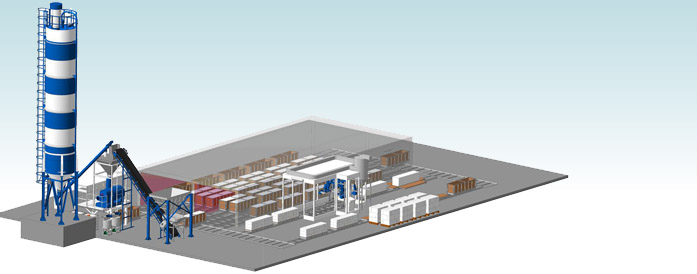
· Automated lines
Aerated concrete is a type of blown-out concrete. Aerated concrete is artificial stone with
spherical pores evenly distributed throughout its volume. Aerated concrete is obtained from a mixture
of binding, siliceous component and water with adding of gas-forming and
modifying agents.
Portland
cement and limestone (gas silicate) are commonly used as binding component. CHP
ash, granulated blast furnace slag and silica sand are commonly used as
siliceous component. As a rule, aluminum powder works as gas forming agent. Adding
of aluminum powder to the mixture causes a chemical change which leads to hydrogen
evolution. In its turn, hydrogen forms pores.
Regulators of structure formation and plastic strength development, hardeners and
plasticizers are used as modifying agents.
Aerated
concrete types
There are many different types of aerated concrete which
are classified according to the following criteria:
1. By functionality:
- structural;
- structural and heat insulating;
- heat insulating.
2. By curing conditions:
- autoclave (synthetic hardening) — hardening in
saturated steam media at pressure above atmospheric;
- non-autoclave (hydration hardening) — hardening under natural conditions with electrical
heating, in saturated steam media at atmospheric pressure.
3. By type of binding component:
- limestone;
- cement;
- mixed;
- slag;
- ash;
4. By type of siliceous component:
- natural materials: floured silica sand and other
kinds of sand;
- secondary products
of industry: CHP fly ash, hydro removal
ash, afterproducts of different ores, ferroalloys waste and etc.
Main
characteristics of aerated concrete
Types of autoclave and non-autoclave aerated concrete
strength are specified by classes according to compression strength, due to ST
SEV 1406.
For aerated concrete the following classes are specified
: В0,5; В0,75; В1; В1,5; В2; В2,5; В3,5; В5; В7,5; В10; В12,5; В15.
For constructions designed without taking into account
requirements of ST SEV 1406 compression strength indexes of aerated concrete
are characterized by marks: М7,5; М10;
М15; М25; М35; М50; М75; М100; М150; М200.
By average density the following marks of aerated
concrete in dry condition are specified: D300; D350; D400; D500;
D600; D700; D800; D900; D1000; D1100; D1200.
The physical and mechanical properties of concrete
types are given in Table 1.
Table 1
The physical and mechanical properties of concrete types
|
Concrete
type
|
Concrete
mark
|
Autoclave
concrete
|
Non-autoclave
concrete
|
|
|
by
average density
|
Class
by compression strength
|
Mark by
cold resistance
|
Class
by compression strength
|
Mark by
cold resistance
|
|
|
D300
|
В0,75
|
|
-
|
-
|
|
|
|
В0,5
|
|
|
|
|
Heat insulating
|
D350
|
В1
|
Is not specified
|
|
|
|
|
|
В0,75
|
|
|
|
|
|
D400
|
В1,5
|
|
В0,75
|
|
|
|
|
В1
|
|
В0,5
|
Is
not specified
|
|
|
D500
|
-
|
-
|
В1
|
|
|
|
|
|
|
В0,75
|
|
|
Structural
and heat insulating
|
D500
|
В2,5
|
|
|
|
|
|
|
В2
|
From F15 to F35
|
-
|
-
|
|
|
|
В1,5
|
|
|
|
|
|
|
В1
|
|
|
|
|
|
D600
|
В3,5
|
|
|
|
|
|
|
B2,5
|
From F15 to F75
|
В2
|
From F15 to F35
|
|
|
|
В2
|
|
В1
|
|
|
|
|
B1,5
|
|
|
|
|
|
|
В5
|
|
В2,5
|
|
|
|
D700
|
В3,5
|
|
В2
|
From F15 to F50
|
|
Structural and heat insulating
|
|
В2,5
|
|
В1,5
|
|
|
|
|
В2
|
From F15 to F100
|
|
|
|
|
|
В7,5
|
|
В3,5
|
|
|
|
D800
|
В5
|
|
В2,5
|
|
|
|
|
В3,5
|
|
В2
|
|
|
|
|
В2,5
|
|
|
From F15 to F75
|
|
|
|
В10
|
|
В5
|
|
|
|
D900
|
В7,5
|
From F15 to F75
|
В3,5
|
|
|
|
|
В5
|
|
В2,5
|
|
|
|
|
В3,5
|
|
|
|
|
|
|
В12,5
|
|
В7,5
|
|
|
|
D1000
|
В10
|
|
В5
|
|
|
|
|
В7,5
|
|
|
|
|
Structural
|
|
|
From F15 to F50
|
|
From F15 to F50
|
|
|
|
В15
|
|
В10
|
|
|
|
D1100
|
В12,5
|
|
В7,5
|
|
|
|
|
В10
|
|
|
|
|
|
D1200
|
В15
|
|
В12,5
|
|
|
|
|
В12,5
|
|
В10
|
|
Drying shrinkage of aerated concrete should be not more than 3,0 mm/m for non-autoclave concrete of marks D600—D1200.
Heat-conductivity coefficients of aerated concrete should not exceed the values given in the Table 2 in more than 20%.
Table 2
Regulated physical and technical properties of aerated concrete types
|
Concrete
type
|
Concrete
mark
|
Coefficient
|
Sorption humidity
of concrete, max %
|
|
|
by
average density
|
Of heat-
conductivity
W/(m ·°С),
max, of ready concrete in dry condition
|
Vapour
permeability
mg/(m · h · Pa),
max, ready concrete
|
at
relative humidity 75 %
|
at
relative humidity 97 %
|
|
|
|
|
|
Ready
concrete
|
|
|
|
With sand
|
With
ash
|
With sand
|
With ash
|
With
sand
|
With
ash
|
With sand
|
With ash
|
|
Heat insulating
|
D300
|
0,08
|
0,08
|
0,26
|
0,23
|
8
|
12
|
12
|
18
|
|
|
D400
|
0,10
|
0,09
|
0,23
|
0,20
|
8
|
12
|
12
|
18
|
|
|
D500
|
0,12
|
0,10
|
0,20
|
0,18
|
8
|
12
|
12
|
18
|
|
Structural
and heat insulating
|
D500
|
0,12
|
0,10
|
0,20
|
0,18
|
8
|
12
|
12
|
18
|
|
|
D600
|
0,14
|
0,13
|
0,17
|
0,16
|
8
|
12
|
12
|
18
|
|
|
D700
|
0,18
|
0,15
|
0,15
|
0,14
|
8
|
12
|
12
|
18
|
|
|
D800
|
0,21
|
0,18
|
0,14
|
0,12
|
10
|
15
|
15
|
22
|
|
|
D900
|
0,24
|
0,20
|
0,12
|
0,11
|
10
|
15
|
15
|
22
|
|
Structural
|
D1000
|
0,29
|
0,23
|
0,11
|
0,10
|
10
|
15
|
15
|
22
|
|
|
D1100
|
0,34
|
0,26
|
0,10
|
0,09
|
10
|
15
|
15
|
22
|
|
|
D1200
|
0,38
|
0,29
|
0,10
|
0,08
|
10
|
15
|
15
|
22
|
|